The Big Four Venomous snakes of India
India is home to more than 300 species of snakes inhabiting diverse landscapes, but only a few of these snake species can cause injury due to venom. Four such species, Common Cobra, Common Krait, Russell’s Viper & Saw-Scaled Viper, are together responsible for more than 95% of snakebite mortality across the country and collectively they are termed …The Big Four.
The Big Four – highly venomous snake species that are widely distributed throughout the country have adapted themselves to survive in human-dominated areas such as farm lands, gardens and even inside homes. Like any other snake, they bite when they feel threatened and their victim is usually a person who was absolutely unaware of the snake’s presence and accidentally got too close to it, or stepped on it, or even tried to pick it up thinking it was piece of rope or something similar. In such cases, the snake will react immediately and try to protect itself by biting the perceived threat.
Spectacled Cobra
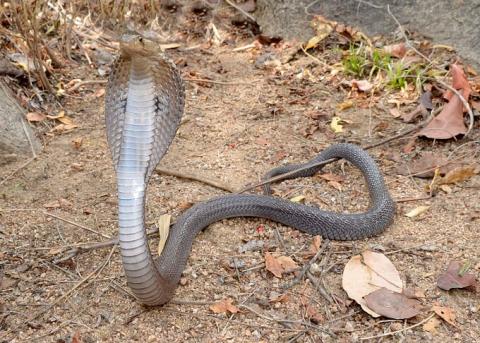
It is the most common and widespread venomous snake of India and is found in a variety of habitats and surroundings. It can be found in forests, near streams, rockpiles, farm lands, buildings, etc. In many parts of the country, they have adapted to live in crowded localities within rat holes or abandoned termite mounds and are usually never even seen by people. The body colour can be between light brown with white speckles to black without any markings at all - even the iconic hood mark. This snake is active both during the day and night. When alarmed it will raise its hood and warn the intruder with a loud hissing noise to warn and will bite forcefully if threatened. Its venom is neurotoxic and works on muscles paralysing the victim and causing respiratory arrest.
Common Krait
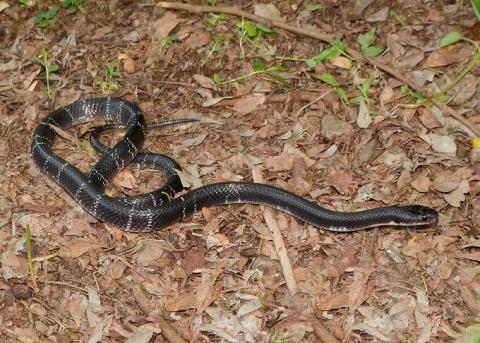
The common krait is active mostly at night and is responsible for a large number of deaths especially in cases where the victim has been asleep on the floor. The body is glossy brown to black with white or creamish white bands (often paired). The bands are usually absent in the forebody region and are replaced by white spots on the vertebral region. It has a large hexagonal scale on the vertebral line. During the day, the snake is not very active and hides in safe places. Found across the country, the common krait is partial to buildings with small hiding places such as wood, tile or brick piles, stacked furniture, etc. The snake bites when threatened and though its bite may not be painful as that of other snakes, its venom (neurotoxic) is the most potent of the Big Four.
Russell's Viper
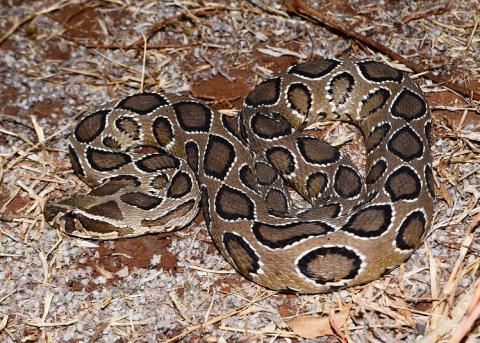
The Russell’s Viper is a widespread member of the Big Four with its venom being hemotoxic/cytotoxic in action, destroying blood and tissues and causing death due to haemorrhage. It has a stout body with highly keeled scales. Head is triangular in shape; eyes have vertical pupils and very large nostrils. The body colour varies between yellowish brown to dark brown and has three series of longitudinal large round or oval spots which may have white or cream margins and touch each other to form a chain-like pattern. In some rare cases, these markings are absent. This viper is mostly nocturnal and is an ambush predator in nature, usually found in grasslands, fields, bushes etc. When disturbed, it emits a loud warning hiss much like a pressure cooker whistle. Bites when threatened and bite process can be very quick without a warning too
Saw-scaled Viper
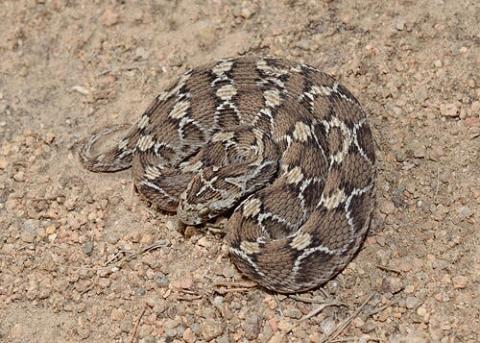
This is the smallest member of the Big Four with limited distribution across the country and is found in open dry, sandy or rocky terrain. It does not occur very commonly in most parts of its known distribution, but is very common in some parts of Rajasthan, Maharashtra and Tamil Nadu. The body colour varies with shades of brown or grey with a zig -zag pattern in light yellow or very light brown. Head is triangular in shape and eyes have vertical pupils. It moves with a fast sidewinding motion. It is mostly nocturnal and hides under rocks or logs during the day. When the snake is disturbed, it will inflate its body and continuously rub its saw-edged scales to make a rasping sound. Strikes very fast when disturbed. Venom is hemotoxic.